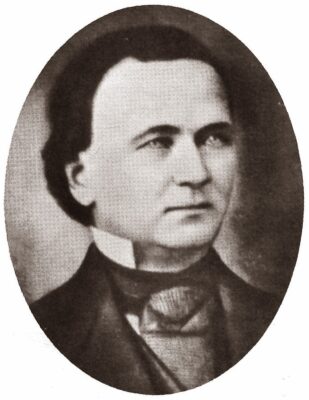
The garment industry has always played an important and essential role in human life, as the saying goes: “Full stomach, warm clothes.” But do you really know the origin of how the garment industry came into existence? Let’s explore it together!

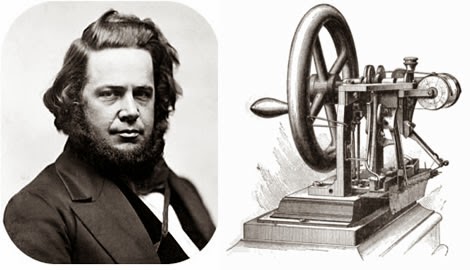
In 1845, the first industrial sewing machine by Elias Howe (1819–1867), an American mechanical engineer, was born and marked a breakthrough in this field with productivity far exceeding traditional hand sewing methods.

Let’s be surprised by the curious fate that led him to invent the industrial sewing machine:
Since 1840, Elias had spent great effort researching this problem but had not yet found a “solution to the difficult puzzle.” The invention came to him in a dream, where he was beheaded by a group of savages and thrown into a cooking pot. He risked everything to crawl out of the pot, but they threatened to stab him with a long spear. At that moment, he noticed a hole at the tip of the spear. This dream led Elias Howe to abandon traditional hand sewing principles. He designed a curved needle with the eye of the needle drilled at the tip, working in tandem with a bobbin to create a stitch. In the 1800s, most clothing was sewn by hand and consumed a great deal of time. Not long after, the first industrial sewing machine invented by Elias Howe was created, marking the beginning of a prosperous era for the textile industry. Uniquely, this machine used an entirely new principle involving two threads—one through the needle hole and piercing the fabric to form a loop, while a shuttle passed a second thread through that loop to create a stitch. Ultimately, Howe completed his great invention, and people came to regard him as the “father of the industrial sewing machine.”
History shows that humans have known how to sew clothes by hand since thousands of years before Christ. The first sewing needles were made from bone or horn, and the thread was made from animal sinew. Iron needles were invented in the 14th century, and needles with eyes began to appear in the 15th century. Many sewing machine inventions appeared as early as 1755, but none worked effectively. The first functional mechanical sewing machine was invented by Barthelemy Thimonnier, a French tailor, in 1830. His machine used one thread and a hooked needle to create a stitch similar to embroidery. A group of French tailors, fearing this invention would make them jobless, angrily burned down Thimonnier’s workshop and nearly killed him. Before that, Walter Hunt successfully built the first hand sewing machine in America in 1834, but he did not patent his invention because he believed it would put many people out of work.